
Water Efficiency Watch – October 2025
Published: October 7, 2025
In this issue...
- 2025 Symposium Recap
- AWE Organizational Updates
- Program Updates
- Research Updates
- Policy Updates
- Member Spotlight
- News Briefs
Water Efficiency & Conservation Symposium
2025 Water Efficiency & Conservation Symposium Recap
Thank you to everyone who helped make our 3rd Annual Water Efficiency & Conservation Symposium a success! Year after year, attendees tell us that the connections they make during the Symposium are just as valuable as the insights gained from the program itself. This year was no exception; whether it was meeting new colleagues at the Welcome Reception hosted at Island Tiki Hut along the Chicago Riverfront, swapping stories over dinner during Restaurant Roundup, or comparing notes between sessions, the sense of camaraderie never ceases to inspire us. We love seeing members come together to share successes and challenges, and to collaborate on solutions to the most pressing issues facing our field.
This year’s two-track program covered a wide range of topics, including “Data Centers & Water: A Conversation at the Crossroads”, “Rising to the Challenge: When Extreme Weather Events Become the New Normal”, and “First Insights from the Residential End Uses of Water Study and the 50L Home Pilot”, along with timely discussions on state and federal policy changes.
The AWE staff and Board of Directors are optimistic that the conversations sparked in Chicago will ripple across North America as attendees return home with fresh insights, new questions, and promising practices to implement in their communities.
Symposium slide decks are available here. Note: you must be signed in to access this page.
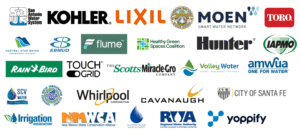
2025 Symposium Sponsors
Thank you to all the generous sponsors partnering with us to host the 3rd Annual Water Efficiency and Conservation Symposium with us in 2025!
AWE Staff Updates
Introducing our New Senior Manager of Programs
In July, we welcomed Johanna DeCotis-Smith to our team as our Senior Manager of Programs! Johanna DeCotis Smith has over 14 years of experience working within the environmental field and has spent 10 years working on a variety of water quantity and quality issues in the State of Georgia. She most recently worked at the Georgia Environmental Protection Division, where she managed the Watershed Compliance Program, as well as engaged with water efficiency, water reuse, and water supply issues as the Manager of the Surface Water Unit in the Water Supply Program. Before joining EPD, Johanna worked at Amec Foster Wheeler as an engineering consultant, now WSP USA.
Johanna earned a Bachelor of Science in Civil Engineering and a Master of Science in Environmental Engineering, both from Georgia Tech. She is also a registered Professional Engineer in Georgia.
Johanna lives in Atlanta with her husband and two kids, and enjoys biking, attending Atlanta United games, and traveling. Johanna is passionate about water efficiency and conservation (even convincing her husband of the benefits of installing a personal water monitoring device in their home).
Program Updates
Talking Data Centers at AWE’s September Water Efficiency Research (WER) Committee Meeting
During the last WER Committee meeting, members examined the growing water demands of data centers. The meeting kicked off with a presentation by the Atlanta Regional Commission, where Celine Benoit provided an overview on data center water use in the Metro Atlanta region and considerations for local communities. Following the presentation, members shared their questions, concerns, and ideas for future research regarding data center water use. Key themes included the need for transparent data and benchmarking on cooling types and regional water use, challenges around permitting and utility involvement, and questions about long-term impacts such as environmental justice, socioeconomic effects, and climate-driven shifts in cooling demand. This conversation underscored both the opportunities and challenges for the water industry driven by data center development and will help inform AWE’s future work in supporting members on this evolving issue.
AWE’s Conservation + AMI (CAMI) Network Convenes on “Advancing Equity Through AMI Data & Programs.”
At the latest CAMI Network meeting, members heard from Randi Jenkins of Austin Water on the utility’s My ATX Water Project where the utility partnered with UT Austin to develop an equity action plan and framework to guide its AMI rollout. The action plan focused on equitable meter deployment, addressing financial hardships from potential bill increases, and digital divide and communications strategies, and has resulted in an estimated 1.71 billion gallons of water savings since 2021. Building on this case study, participants discussed how utilities are using AMI to advance equitable conservation—through leak detection and notifications, irrigation reminders, and commercial benchmarking—while also connecting customers to repair resources and financial assistance. The conversation highlighted both the opportunities and risks of AMI for vulnerable households and underscored the importance of multilingual communication, trust-building outreach, and balancing enforcement with support.
AWE Connects with CalWEP Partners at the CalWEP Fall Plenary
Johanna DeCotis Smith attended the CalWEP Fall Plenary in Los Angeles, CA, to provide AWE updates and build connections with our CalWEP partners in person. CalWEP provided updates about its ongoing efforts to improve equity and engagement in water conservation using its new Multilingual Glossary and Community Insights Tool and its work to help CalWEP members more easily comply with new non-functional turf (NFT) legislation in California using a Comprehensive NFT Toolkit. CalWEP member agencies also provided insight into creative approaches, best practices, and lessons learned to comply with California’s Leak Registry requirements.
Research Updates
Kicking Off WRF #5335, “Per Capita Water Use Calculation”
Water providers, planners, and regulators all rely on per capita water use — but what that number reflects can vary wildly. Better metrics can lead to smarter decisions, better planning, and more trust in data — but first, we need consistency. AWE, The Brendle Group, and Pacific Institute will be tackling this industry-wide challenge as partners on The Water Research Foundation (WRF)’s project #5335, “Per Capita Water Use Calculation.” This project aims to evaluate and standardize the calculation of per capita water use across North America by developing a universally applicable framework and Excel-based tool grounded in stakeholder input, past research, and aligned methodologies. The project will enhance comparability, support effective water planning, and lay the foundation for a future AWWA standard through practical application, clear guidance, and replicable case studies across diverse contexts. Thank you WRF for providing funding support for this initiative!
Participate in AWE’s Research Project, “Characterizing Water Use in Low-Income Households”
With generous funding from the Metropolitan Water District of Southern California’s Innovative Conservation Program (ICP), AWE is excited to have kicked off its latest water affordability initiative, a research project titled “Characterizing Water Use in Low Income Households.” Building off of AWE’s 2024 policy white paper, this project will explore and characterize the extent to which leaks from inefficient appliances and fixtures contribute to immediate and long-term household water affordability challenges. The project aims to help shape proactive, preventative programs that seek to address both short-term and long-term challenges associated with water affordability and may support the creation and implementation of local, state, and/or federal water efficiency and infrastructure repair assistance programs.
We are looking for water utilities in California & beyond to participate in this study. Contact devin@a4we.org to express your interest or for more information.
Participate in AWE’s 2025 AMI Engagement Benchmarking Survey
Is your utility using AMI to engage with customers or thinking about it? Take AWE’s industry-wide AMI Engagement Benchmarking Survey.
- Why? Help us benchmark how water providers across North America are leveraging AMI data to advance conservation and efficiency through customer engagement and leak notification programs.
- Who? Water agencies and utilities. Even if your utility doesn’t have AMI yet, your input still matters!
- How? It takes ~1 hour to complete. All responses are confidential.
- When? Complete it by Friday, October 31st.
Publication Coming Soon: Peak Water Demand Trends and Management Strategies Across North America
AWE submitted its final report for WRF #5265. The report explores peak demands drivers and trends across four core case studies, identifies peak demand management strategies and considerations, and provides examples and guidance for how to adopt and advance strategies across a diverse range of geographical, organizational, and demographic constraints. The report will be published on WRF’s website in the coming months.
AWE would like to express gratitude to WRF for their funding and support, and to the project’s participants – Metropolitan North Georgia Water Planning District, City of Westminster, California Water Service, New Jersey American Water, San Antonio Water System, North Texas Water Development Board, City of Bozeman, and Regional of Peel – for contributing their time, data, and expertise to this effort.
To stay up to date with AWE’s research, check out the Active Research section on our webpage here.
Policy Updates
Championing the Water Conservation Rebate Tax Parity Act
AWE continues to advocate for passage of the Water Conservation Rebate Tax Parity Act—bipartisan, bicameral legislation that would eliminate federal taxation of water efficiency rebates, a disincentive to participation, and an administrative burden for agencies that issue them. Throughout Q3, AWE met with members and their respective Congressional delegations, particularly across the Colorado River Basin, to build support and encourage additional cosponsors in both chambers. We remain optimistic about the growing momentum for this commonsense reform.
Organizations interested in getting involved can reach out to AWE Director of Public Affairs, Kelly Connolly Kern at kelly@a4we.org.
AWE Partnering to Defend ENERGY STAR & WaterSense Funding
Since the start of the new administration, Alliance for Water Efficiency has been actively engaged in a national coalition working to defend the voluntary ENERGY STAR and WaterSense programs, as well as longstanding federal water and energy efficiency standards.
The Senate and House appropriations committees have voted to continue funding for the WaterSense and ENERGY STAR programs at levels consistent with prior years. While the Administration’s budget proposal recommended eliminating funding for ENERGY STAR, the Trump administration appears to support WaterSense, albeit operating at a slower pace. Both programs continue to enjoy broad, bipartisan support. Manufacturers, retailers, utilities, and advocates alike recognize the value WaterSense and ENERGY STAR offer, and Congressional appropriators maintained their funding accordingly. AWE has collaborated with various partners, including Plumbing Manufacturers International, IAPMO, and the Appliance Standards Awareness Project, to secure support for these programs in Congress.
AWE Defends Federal Efficiency Standards for Appliances and Plumbing Fixtures
Congress is considering changes to the U.S. Department of Energy’s efficiency standards under the Energy Policy and Conservation Act (EPCA); long-standing protections that apply to appliances and plumbing fixtures such as dishwashers, clothes washers, toilets, and showerheads. At a recent House Energy Subcommittee hearing, lawmakers debated H.R. 4626, the “Don’t Mess with My Home Appliances Act,” which would make it easier for DOE to amend or roll back these standards and require tougher proof of energy and water savings.
These standards have saved consumers billions of dollars and driven major reductions in both energy and water use nationwide. AWE strongly supports EPCA’s appliance and plumbing fixture standards and opposes efforts to weaken them. We are closely monitoring these developments and will continue to keep members informed on how any changes could impact water conservation and efficiency efforts. Read the article in Utility Dive for full details
To stay up to date with AWE’s policy work, check out our Policy Priorities and Policy Activities sections of our website.
Recent Webinars
Advancing Sustainability Through Household Consumer Products Guidance Webinar
Join AWE on October 21, 2025 (1–2 p.m. CST) for the release of our groundbreaking new report, Advancing Sustainability Through Household Consumer Products: Guidance & Insights for Estimating & Communicating Water Savings.
Developed in partnership with Bluerisk and supported by Procter & Gamble through the Bonneville Environmental Foundation, this tool provides a practical framework to help guide companies and researchers consistently estimate and communicate water savings from household consumer products and campaigns.
During this webinar, experts will share why household water use matters, showcase pilot project results from the 50L Home Pilot, and walk through the report’s guidance. You’ll leave with actionable insights to improve the credibility and impact of water-saving products and programs. Register here.
Texas Drought Enforcement Webinar
The Texas Section AWWA, AWWA, and AWE hosted a webinar on drought enforcement on Wednesday, May 28th.
Current weather is heating up, which means summer and “watering season” are on the way! This informative webcast presented the current weather conditions and summer outlook across Texas. Watch the recording to hear from representatives with AWWA and AWE about available resources for utilities on drought messaging, strategies, and studies. And we’ll hear from some utilities about the strategies that are working for them when it comes to enforcing drought restrictions and educating their customers. Watch the recording here.
AWE Member Spotlights
City of Phoenix and IAPMO Partner Together
Earlier this summer, the City of Phoenix announced the adoption of the 2024 Phoenix Building Construction Code, which incorporates the 2024 edition of IAPMO’s Uniform Plumbing Code® and Appendix M: the Water Demand Calculator—a breakthrough tool for modern plumbing design. Implementation of the new code began on August 1st of this year.
“The Uniform Plumbing Code and the Water Demand Calculator empower plumbing professionals to design right-sized systems that reduce construction costs, conserve water, and deliver hot water more efficiently,” said IAPMO CEO Dave Viola. “We applaud Phoenix for taking this important step toward building a more resilient, equitable, and sustainable city.” Congratulations to the City of Phoenix and IAPMO for partnering together to improve water and energy efficiency and quality through the adoption of this code!
Town of Ipswich Shares Drought Resources
Rachael Belisle-Toler, Water Resources Manager with Ipswich Utilities in Massachusetts, was recently featured in her local paper sharing ways that residents can take advantage of the water department’s resources and in-house expertise to save water and effectively navigate the drought that the area is facing. The utility offers a range of resources to residents including rebates for rain water harvesting and high-efficiency appliances and one-on-one technical assistance to help residents create drought tolerant landscaping on their properties.
Congratulations to Rachael, AWE’s 2024 Up & Comer Awardee, for leading the way in Ipswich and empowering neighbors and customers with the information they need to save water and money!
New Research on Indoor Water Use Across U.S. Homes Features Data from AWE Members
A new study released earlier this summer, Patterns and Predictors of Residential Indoor Water Use Across Major U.S. Cities, coauthored by AWE member and 2025 Water Star Awardee Peter Mayer, provides one of the largest snapshots to date of how Americans use water inside their homes. Using data from more than 26,000 single-family households across 39 cities, collected by AWE business member Flume, the research shows toilets account for roughly 40% of indoor water use, followed by showers at about 30%. Dishwashers, on the other hand, used the least.
The study also uncovered interesting trends: humidifier use is strongly linked to higher overall consumption, while older homes (built before 1985) were associated with lower usage. Published in Earth’s Future, the findings offer valuable insights to help communities and utilities design more effective conservation strategies.
Northern Water’s Sustainable Landscape Templates
After the 2021 Marshall Fire destroyed more than 1,000 homes, Northern Water partnered with Norris Design, community stakeholders, and an advisory committee to create six free, scalable landscape templates for rebuilding and beyond. Featured recently in this article by AWWA, these templates help homeowners design yards that are fire-smart, water-wise, and pollinator-friendly, complete with irrigation details, plant lists, cost estimates, and maintenance guides. Covering a range of lot types, the plans make sustainable landscaping accessible and practical, while Northern Water’s new demonstration gardens bring the designs to life for the community. Check out Northern Water’s six templates here.
Upper Trinity Regional Water District
Congratulations to our Texas member, Upper Trinity Regional Water District, on the success of its “Give a Drip” public awareness campaign launched earlier this year. Promoted throughout their service area, the campaign encourages residents to conserve water, follow local watering schedules, and reduce their environmental impact. The online resource hub offers practical tools, including irrigation system tips, lawn and garden guidance, native plant ideas, and weekly watering reminders.
The Town of Flower Mound, one of Upper Trinity’s customer cities, took the campaign a step further by creating a fun, in-house “Give a Drip” music video, bringing the message to life with creativity and local flair. Click here to listen to this summer’s best water efficiency ballad!
News Briefs
Move Over, Green Lawns. Drier, Warmer Climate Boosts Interest in Low-Water Landscaping. Read More.
For the Future of Water Conservation, Look to…Los Angeles. Read More.
‘Interesting Bedfellows’ Unite to Save ENERGY STAR Label. Read More.
Proposed Data Center Prompts Tucson to Regulate Large Water Users, Require Conservation. Read More.
Amid ‘Tense’ Colorado River Negotiations, Water Summit Keeps Focus on Conservation Efforts. Read More.
Humanity is Rapidly Depleting Water, and Much of the World is Getting Drier. Read more.