
Research
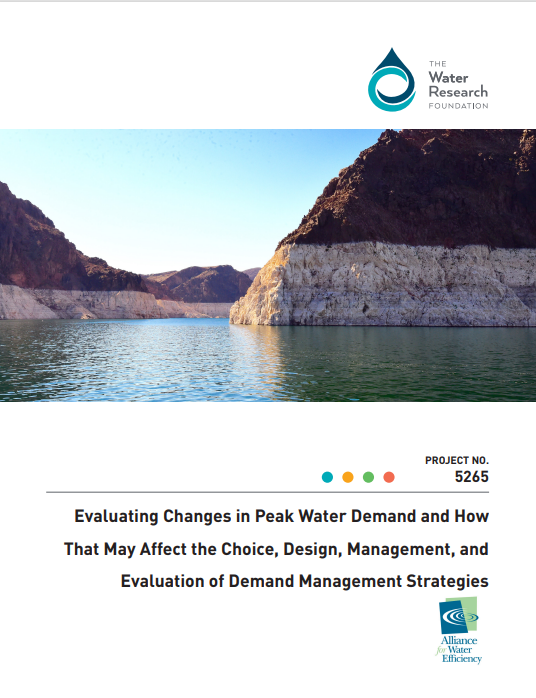
Evaluating Changes in Peak Water Demand (WRF 5265)
Thank you to The Water Research Foundation (WRF) for funding and supporting this project. Access and download the published report on their website.
Project Overview
AWE’s research on the Water Research Foundation's project 5265 Evaluating Changes in Peak Water Demand and How That May Affect the Choice, Design, Management, and Evaluation of Demand Management Strategies examined peak demand strategies, as well as the costs and benefits of deploying them. By evaluating which water efficiency and conservation strategies are most effective in reducing peak demand—including when, where, and how to deploy them—conservation teams can work more effectively in concert with utility operations and capital planning teams.
Water providers employ water efficiency and conservation programs, policies, and regulations to reduce peak demand, thereby lessening the need for infrastructure expansion and higher operating expenses. Peak demand management also helps ensure reliable water supplies as climate change contributes to more frequent and severe droughts.
Key Research Benefits
- Shares a new lens for measuring daily and seasonal peak demand data. The analyses incorporated across four case studies provide a perspective on how to evaluate a shift in seasonal peaks and variation in daily peak metrics.
- Derives a linear relationship between monthly water production and average monthly temperature that can aid utilities in evaluating water demand response to increasing temperatures.
- Helps utilities identify and compare real-world strategies for managing peak water demand under varying system, climate, and regulatory conditions, and provides concrete examples and planning excerpts to support policy development and program innovation.
- Informs utility staff and planners about emerging metrics and methods to better evaluate and track peak-related impacts.
- Offers a first-of-its-kind synthesis of peak demand management strategies across diverse geographies and utility types.
- Lays the groundwork for energy and cost savings by reducing the need for energy-intensive water treatment and pumping during peak demand periods. Strategic demand management strategies can reduce energy spikes, lower greenhouse gas emissions, defer infrastructure expansion, and support more sustainable long-term utility planning.