Applications Open November 16th @ 10am CT:

Fundamentals of Water Efficiency & Conservation

A 12-week training course for emerging professionals in water efficiency & conservation.

White water tower with a blue wave mural, set against a clear blue sky and distant hills.

About the Program

This 12-week training program combines online synchronous sessions and asynchronous discovery tasks.

Program Dates: March 18 – June 10, 2027

Participants will build capacities through:

Expert-Led Learning
Core concepts in water conservation, efficiency, and demand management

Applied Skills
Practical skills for program planning, implementation, and evaluation

Peer Connection
Networking opportunities and insight into career pathways in the water sector

Venn diagram with three overlapping circles labeled Expert-Led Learning (green), Applied Skills (teal), and Peer Connections (blue) showing core learning components.

Interested?

The application for the Fundamentals training will be open from November 16 - February 1 with eligible candidates accepted on a first-come, first-serve basis. Participants may be limited from a single organization based on demand.

Sign up to receive more info

Who should participate?

Current Professionals Seeking Foundational Knowledge in Water Conservation and Efficiency

For those new to the field or holding broader roles that include water efficiency & conservation.

Work Setting

Those responsible for or interested in water conservation and efficiency within:

  • Water service providers
  • Government agencies
  • Environmental non-profits
  • Industry service providers/consultants
  • Product manufacturers

Current AWE Members

If you are not currently a member and interested in learning more, click here or email membership@a4we.org.

Line drawing of a person in profile with a large question mark looping around their head, on a light blue watercolor background, conveying uncertainty or inquiry.

Fundamentals Training Details

High-level Curriculum Overview

  • Introductory Session: Course Orientation & Why Water Efficiency Matters
  • Module 1: Introduction to Water Systems and Water Efficiency & Conservation Strategies
  • Module 2: Key Terminology, Metrics, and Water Use by Sector
  • Module 3: Water Use Regulations, Policies, and Rates
  • Module 4: Conservation Planning for Drought, Emergencies, Climate Change
  • Module 5: Translating Data to Action
  • Closing Session: Reflection, Career Pathways, and Next Steps

Important Dates & Deadlines

  • November 16: Application Opens
  • January 15: Application Closes
  • February 1: Candidate Informed
  • February 22: Participant confirmation deadline, unclaimed spots offered to waitlisted applicants
  • March 18 – June 10: Program Dates
  • August 3-6: Optional special event for participants at Water Efficiency & Conservation Symposium

Asynchronous tasks will be due before and after the program dates.

Time Commitment & Expectations

This 12-week program includes:

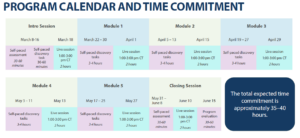
  • Seven two-hour synchronous meetings
  • Six asynchronous assignments requiring approximately 3–4 hours each
  • Pre- and post-course assessments and a program evaluation requiring approximately 30–60 minutes each

The total expected time commitment is approximately 35–40 hours.

To successfully complete the course, participants must attend at least six of the seven synchronous meetings, complete all asynchronous assignments, and submit the pre- and post-course assessments and program evaluation. Meetings and assignments will alternate throughout the program.

Registration Fee

2027 Pilot Program Fee: $350

The 2027 pilot program is available exclusively to AWE members at a reduced introductory rate of $350. Fees for future offerings will reflect the full cost of delivering the training. Future programs may also be open to non-members at a higher rate.

Frequently Asked Questions

  • Question: Is this program an accredited certification? Could it become accredited retroactively?
  • Answer: Participants who meet the program requirements will receive a certificate of completion, rather than an accredited professional certification. There are no plans for retroactive accreditation, however developing a national certification for water efficiency and conservation professionals may be developed in the future.


  • Question: How does this training differ from the CA-NV AWWA Water Use Efficiency Practitioner (WUEP) certification?
  • Answer:  AWE’s Fundamentals training builds foundational knowledge and practical skills for professionals across North America who are new to water efficiency and conservation or whose roles only partly involve this work. The WUEP certification was developed for practitioners in California and Nevada and assesses professional competency at three levels through examinations.


  • Question: Is this training only for utility employees?
  • Answer: No. The training is designed for professionals across sectors. Participants will explore their local water systems, rates, and conservation strategies and consider how these topics relate to their own roles and organizations.


  • Question: How will participants access training materials and submit assignments?
  • Answer: Google Classroom will serve as the central platform for accessing training materials and submitting assignments.


  • Question: Is the training relevant to Canadian participants, particularly the sessions on legislation and policy?
  • Answer: Yes. The training takes a North American perspective, although some examples and case studies will be from the United States. Participants will explore how regulations and policies apply to their own local water systems and water use.


  • Questions: Are all required meetings virtual?
  • Answer: Yes. All required meetings will be virtual. Participants will also be encouraged to attend AWE’s Water Efficiency & Conservation Symposium in Chicago, but attendance is optional.


  • Question: Will presentations be live or recorded and completed independently?
  • Answer: All presentations will be delivered live during scheduled virtual sessions and will include opportunities for discussion and collaboration.


  • Question: Is there a limit on participants from a single organization?
  • Answer: The pilot program is capped at 30 participants. Depending on demand, AWE may limit participation from individual organizations to allow a broader range of organizations to participate.

What to Expect

This cohort-based training combines self-paced discovery tasks with expert-led live sessions. Participants will gain practical skills they can apply in their current roles, build a network of peers and mentors, and explore pathways to a meaningful career in water efficiency and conservation.

Sample Module Format

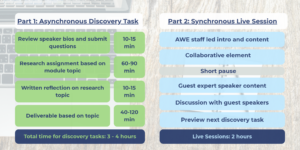
Each two-week module follows a flipped learning format: participants explore topics through self-paced discovery tasks in week one, then join AWE staff, expert guest speakers, and fellow participants for a collaborative live session in week two.
Questions? Reach out to membership@a4we.org.

Program Schedule

View Info Session

Learn more about the program through materials from our October 28, 2026 information session.

Info Session Materials